Part One
Quantum Mechanics: Huygens’ Principle Is Fractal
The Huygens–Fresnel principle states that every point on a wavefront is itself the source of spherical wavelets and that the secondary wavelets emanating from different points mutually interfere. The diagram below (taken from page 5 of Richard Feynman’s Quantum Mechanics and Path Integrals) explains how Huygens’ principle can be applied to quantum waves.
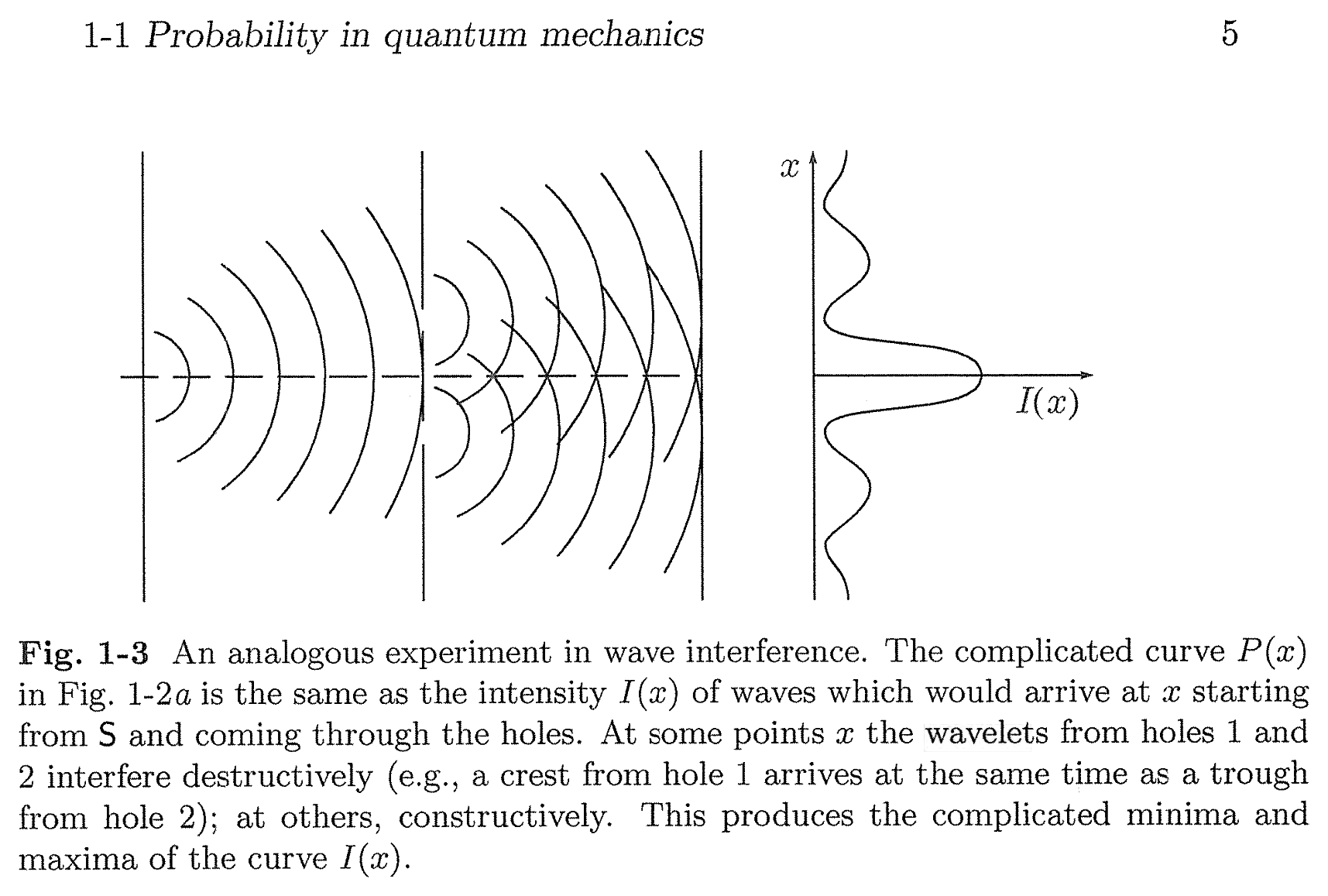
This apparently mild transition from a particle-based view of causality to a wave-based picture has surprising implications for our picture of the structure of reality. Because it assumes a continuous set of possible paths, Feynman’s path integral is equivalent to the wave description. In it, each point in space serves as a source of possible paths. However, because it is wave mechanics, we know that the paths are not really “possible” but actual (they mutually interfere with one another). Recall what Feynman said about this earlier:
“Now we can give the quantum-mechanical rule. We must say how much each trajectory contributes to the total amplitude to go from a to b. It is not just the particular path of extreme action that contributes; rather, all the paths contribute. They contribute equal magnitudes to the total amplitude, but contribute at different phases. The phase of the contribution for a given path is the action S for that path in units of the quantum of action ℏ… all paths contribute equally, although their phases vary, so it is not clear how, in the classical limit, some particular path becomes most important… The net amplitude to arrive at this position x′ at the time T + t′ can be considered as the sum of contributions from every trajectory that goes from the origin to the final point.”
— Richard Feynman, Quantum Mechanics and Path Integrals, pp. 28, 29, 47
Now, bearing in mind that all the paths are real, physical trajectories, let’s follow them across scale. Start with a path of a certain width, say a millionth of a meter wide, and zoom in on part of it as far as you like, say 1,000 times, to isolate a 10−9 meter strand. What does quantum mechanics say you will find in that thread? More paths! Obeying what principle? Huygens’! Meaning what exactly? There is structure at every scale.
The following diagram is taken from page 177 of Richard Feynman’s Quantum Mechanics and Path Integrals. Note the nested “magnifying glasses” showing paths within paths. The single trajectory detailed here is a single hypothetical trajectory chosen out of the continuous space of all possible paths for easy visualization. In reality there is an infinite family of trajectories branching downwards into ever finer scales.
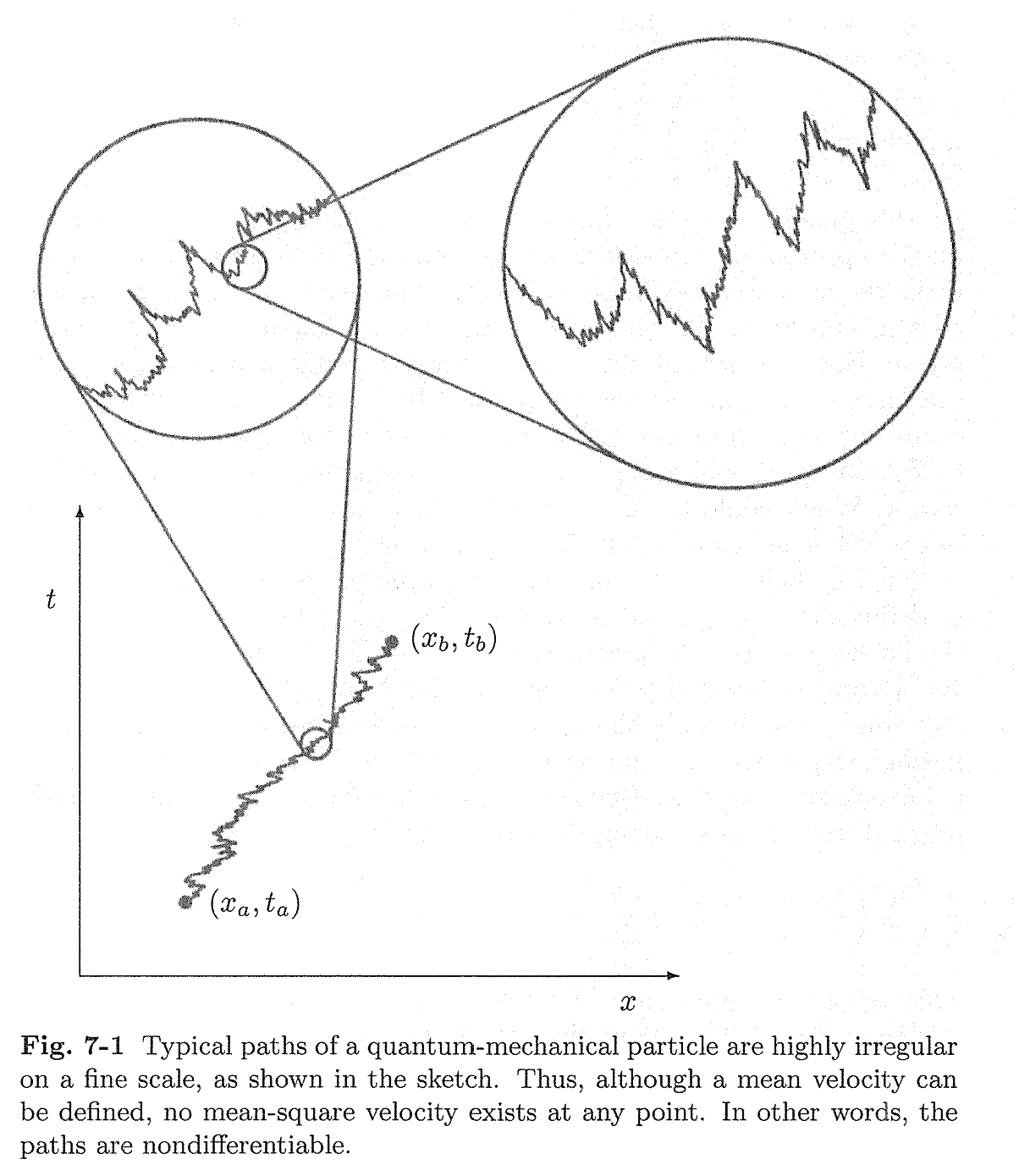
“It appears that quantum-mechanical paths are very irregular. However, these irregularities average out over a reasonable length of time to produce a reasonable drift, or ‘average’ velocity, although for short intervals of time the ‘average’ value of the velocity is very high.”
— Richard Feynman, Quantum Mechanics and Path Integrals, p. 177
Part Two
General Relativity Is Fractal
“We arrive, then, at the result that space is of three dimensions. Is this, then, one of the postulates of the science of space? No; it is not. The science of space, as we have it, deals with relations of distance existing in a certain space of three dimensions, but it does not at all require us to assume that no relations of distance are possible in aggregates of more than three dimensions.”
— William Kingdon Clifford, Philosophy of the Pure Sciences (1875), pp. 364, 365
The fractal nature of Huygens’ principle is intrinsically connected to our assumption of the continuity of space. This assumption is made mathematically by the default belief in the continuity of the real number line, on which the Schrödinger equation is based mathematically. This belief is equally present in general relativity:
“As the first of the postulates of the science of space, then, we must reckon this postulate of Continuity; according to which… between every two points on a line there is an infinite number of intermediate points.”
— William Kingdon Clifford, Philosophy of the Pure Sciences (1875), p. 369
What Fig. 7-1 shows is that causality is inherently fractal. Given this, we might expect to find fractal structures in the theory of general relativity. This seems to be what Weyl has done :
“A more detailed scrutiny of a surface might disclose that what we had considered an elementary piece in reality has tiny handles attached to it which change the connectivity character of the piece, and that a microscope of ever greater magnification would reveal ever new topological complications of this type, ad infinitum. The Riemann point of view allows, also for real space, topological conditions entirely different from those realized by Euclidean space. I believe that only on the basis of the freer and more general conception of geometry which had been brought out by the development of mathematics during the last century, and with an open mind for the imaginative possibilities which it has revealed, can a philosophically fruitful attack upon the space problem be undertaken.”
— Hermann Weyl (English ed. 1949; original German ed. 1927), as quoted in Misner, Thorne & Wheeler, Gravitation (1973), p. 221
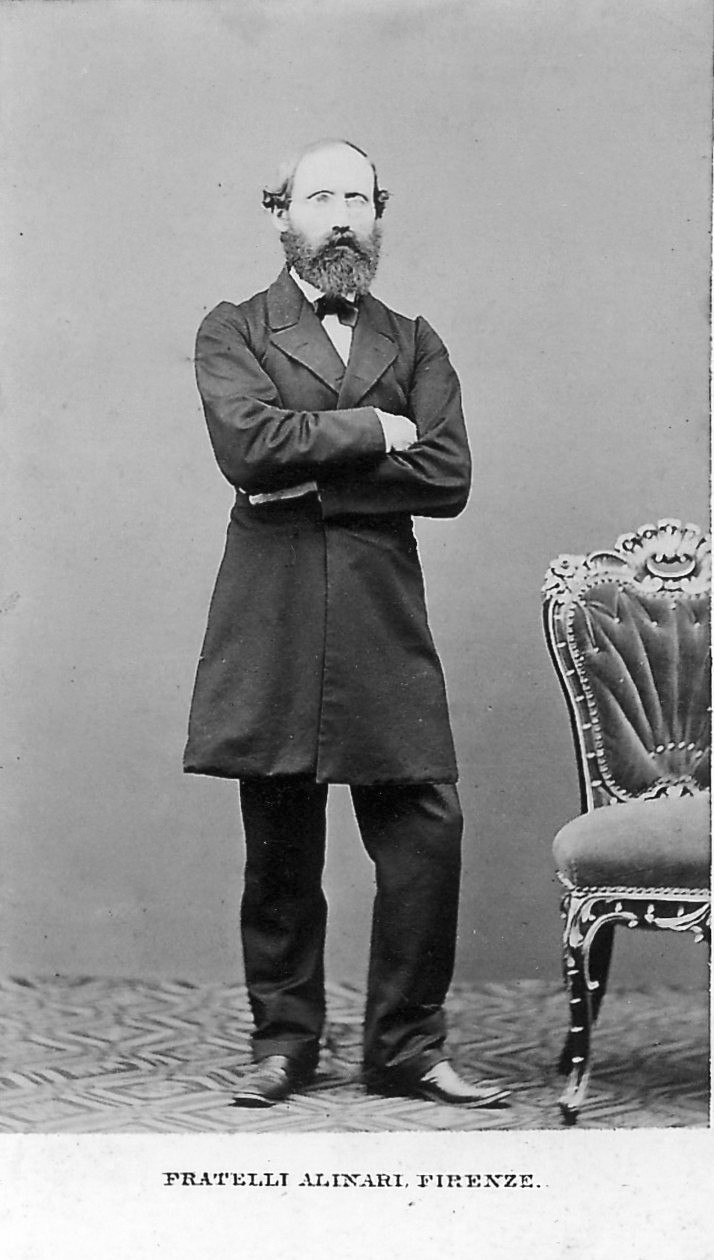
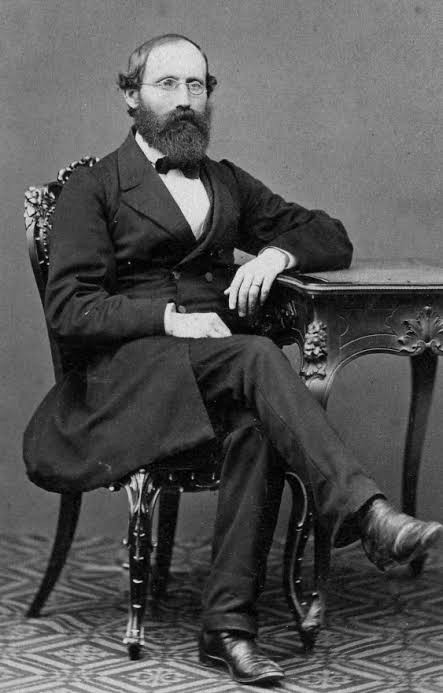
Bernhard Riemann’s foundational 1854 lecture On the Hypotheses which Lie at the Bases of Geometry was the moment Bernhard Riemann first presented Riemannian geometry to the public. Ironically, he gave the lecture specifically to secure a lowly academic teaching position. He was fighting for the lowest rung on the academic ladder: the status of Privatdozent (an unrecognized, completely unpaid lecturer). It is ironic because, though he was in financial poverty and his intellectual abilities were unrecognized at the time, his work would go on to form the mathematical foundation of Albert Einstein’s General Relativity.
The following words of Riemann’s give us some idea as to where Weyl got the idea for an infinitely deep zoom into fractal space-time:
“It is upon the exactness with which we follow phenomena into the infinitely small that our knowledge of their causal relations essentially depends… in the natural sciences which are still in want of simple principles for such constructions, we seek to discover the causal relations by following the phenomena into great minuteness, so far as the microscope permits. Questions about the measure-relations of space in the infinitely small are not therefore superfluous questions… Now it seems that the empirical notions on which the metrical determinations of space are founded, the notion of a solid body and of a ray of light, cease to be valid for the infinitely small. We are therefore quite at liberty to suppose that the metric relations of space in the infinitely small do not conform to the hypotheses of geometry; and we ought in fact to suppose it, if we can thereby obtain a simpler explanation of phenomena.”
— Bernhard Riemann, On the Hypotheses which Lie at the Bases of Geometry, trans. William Kingdon Clifford, Nature 8 (1873)
Fractal structure in GR seems to suggest itself from the very outset. The reason Riemann feels compelled to zoom into the infinitely small is not clear to me, nor do I see why Weyl followed after him, even going so far as to imagine complex structures, but I trust their authority in this matter enough to follow them, at least provisionally, to see what physical reasoning inspired them down this rabbit hole. Its appearance at the very foundations of General Relativity is itself enough of a lure to draw tremendous interest, but what I find most striking about this is its deep connection to Feynman’s picture of fractal branching paths, which he illustrates using a diagram of a microscope of ever greater magnification. Indeed, Feynman’s and Riemann’s pictures are hard to distinguish at this stage, and one cannot help but suspect that they are describing the same physical reality. Of course fractals are nothing new in physics, but the fractal nature of QM, while nominally well known (e.g., infinite sums over Feynman diagrams), is often overlooked due to the stultifying perspective of the Copenhagen interpretation. The fractal nature of GR existing before adding any quantum assumptions is likewise under-appreciated as a fundamental aspect of relativity. Riemann warned us of just this situation:
“Researches starting from general notions, like the investigation we just made, can only be useful in preventing this work from being hampered by too narrow views, and progress in knowledge of the interdependence of things from being checked by traditional prejudices.”
— Bernhard Riemann, On the Hypotheses which Lie at the Bases of Geometry, trans. William Kingdon Clifford, Nature 8 (1873)
Weyl explains that before Einstein, Riemann’s ideas on space were under-appreciated. It may be that the inherent fractality of space-time is still yet to be recognized:
“It would appear from this that out of the rich abundance of possible geometries included in Riemann’s conception, only the three special cases mentioned come into consideration from the outset, and that all the others must be rejected without further examination as being of no account… Riemann held a different opinion, as is evidenced by the concluding remarks of his essay. Their full purport was not grasped by his contemporaries, and his words died away almost unheard (with the exception of W. K. Clifford).”
— Hermann Weyl, Space-Time-Matter (1952), p. 97
Clifford follows Riemann’s reasoning:
“Any curved surface which is such that the more you magnify it the flatter it gets is said to possess the property of elementary flatness. But if every succeeding power of our imaginary microscope disclosed new wrinkles and inequalities without end, then we should say that the surface did not possess the property of elementary flatness… The smoothest surface that can be made is the one most completely covered with the minutest ruts and furrows… yet geometrical construction can be made with extreme accuracy upon such a surface, on the supposition that it is an exact plane. If, therefore, the sharp points, edges and furrows of space are only small enough, there will be nothing to hinder our conviction of its elementary flatness. It has even been pointed out by Riemann that we must not shrink from this supposition if it is found useful in explaining physical phenomena.”
— William Kingdon Clifford, Philosophy of the Pure Sciences (1875), pp. 370, 385, 386
Part Three
The Wave-Like Nature of General Relativity
Six years after reading Riemann’s 1867 paper On the Hypotheses which Lie at the Bases of Geometry, William Kingdon Clifford wrote the short essay On the Space-Theory of Matter. His work is interesting because it emphasizes the wave nature of matter in the framework of general relativity:
“Riemann has shewn that as there are different kinds of lines and surfaces, so there are different kinds of space of three dimensions; and that we can only find out by experience to which of these kinds the space in which we live belongs. In particular, the axioms of plane geometry are true within the limits of experiment on the surface of a sheet of paper, and yet we know that the sheet is really covered with a number of small ridges and furrows, upon which (the total curvature not being zero) these axioms are not true. Similarly, he says, although the axioms of solid geometry are true within the limits of experiment for finite portions of our space, yet we have no reason to conclude that they are true for very small portions; and if any help can be got thereby for the explanation of physical phenomena, we may have reason to conclude that they are not true for very small portions of space.
I wish here to indicate a manner in which these speculations may be applied to the investigation of physical phenomena. I hold in fact
- (1) That small portions of space are in fact of a nature analogous to little hills on a surface which is on the average flat; namely, that the ordinary laws of geometry are not valid in them.
- (2) That this property of being curved or distorted is continually being passed on from one portion of space to another after the manner of a wave.
- (3) That this variation of the curvature of space is what really happens in that phenomenon which we call the motion of matter, whether ponderable or etherial.
- (4) That in the physical world nothing else takes place but this variation, subject (possibly) to the law of continuity.
I am endeavouring in a general way to explain the laws of double refraction on this hypothesis, but have not yet arrived at any results sufficiently decisive to be communicated.”
— William Kingdon Clifford, On the Space-Theory of Matter (1870)
The main physical point of this is that particles are not waves in space, but waves of space.